Would ETS2 Hurt the Economy?
by Orsolya Keményffy and András Lukács
(Clean Air Action Group, Hungary)
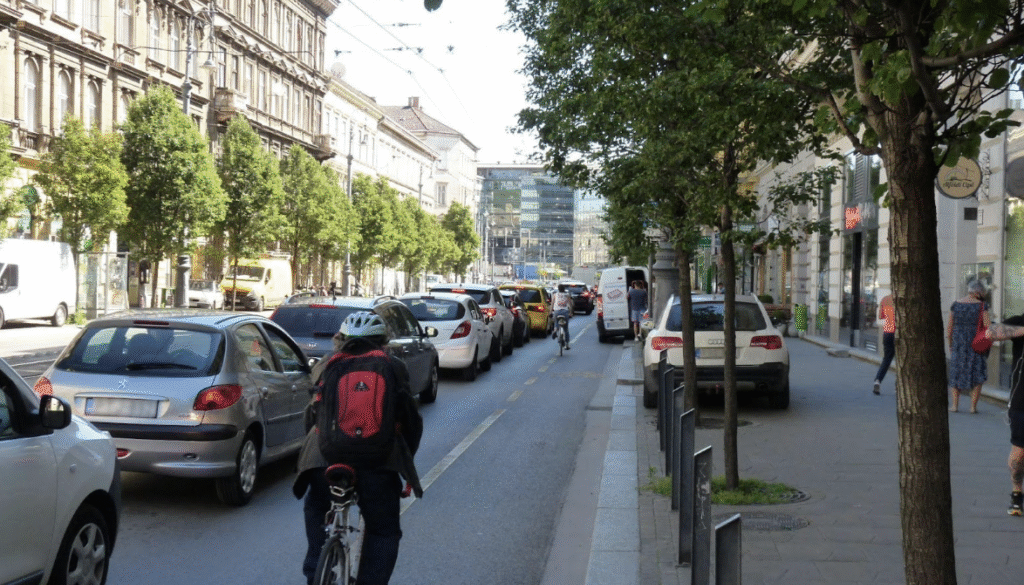
Photo by Ferenc Susánszky, Clean Air Action Group
Several governments have begun advocating for the postponement of ETS2, the EU’s new emissions trading system that covers buildings and road transport. This paper argues that ETS2 is essential not only for climate action but also for modernising our economy. Namely, thanks to abundant public funding, many obsolete businesses have been able to survive. Thanks to ETS2, these businesses would diminish, making way for more resilient businesses that have less of an environmental impact. ETS2 will also boost GDP, generate revenues to fairly compensate households and preserve their purchasing power, foster fairer competition by removing harmful subsidies, boost innovation, and simultaneously mitigate climate- and security-related macroeconomic risks.
In response to the escalating climate crisis, the EU has adopted the European Green Deal and its legislative package, the Fit for 55 aiming to reduce the EU’s greenhouse gas emissions by 55% by 2030 (compared to 1990 levels) and to reach climate neutrality by 2050.
A key pillar of this transition is the EU Emissions Trading System (ETS), launched in 2005. Based on the “polluter pays” principle, it operates as a cap-and-trade system, setting a total emissions cap, within which allowances are traded among companies. The cap gradually declines, making greenhouse gas (GHG) emissions less profitable and stimulating investment in cleaner technologies, thus supporting the EU’s long-term climate goals.
The buildings and road transport sectors have not been previously included in the ETS. and have shown an increase in CO2 emissions during recent decades . To spur carbon-neutrality in these sectors the original ETS will be extended to cover them as a separate trading system (“ETS2”), starting in 2027. To help vulnerable households and small businesses cope with the costs due to the new system, the Social Climate Fund was established.
However, political support for the implementation of ETS2 continues to wane. Several governments (including Bulgaria, Czechia, and Poland, as well as Estonia and Hungary) have already expressed their intention to delay the implementation of ETS2, allegedly because of the negative impact it would have on their economy. Facts, however, prove that such fears are groundless.
ETS2 can increase GDP
The recently published OECD-UNDP Report “Investing in Climate for Growth and Development” challenges postponement-based arguments, showing that an ambitious, economy-wide carbon-pricing can actually boost GDP over both the medium and long term. Expanding ETS-style carbon pricing systems (ETS2) to new sectors does not necessarily result in economic harm. On the contrary, through well-designed revenue recycling and investment-led transition support, it can drive modest near-term growth and deliver substantially larger benefits in the long run.
Under the “Enhanced Nationally Determined Contributions (NDCs)” scenario (which aligns with a well-below 2°C pathway global GDP in 2040 will be 0.2% higher than under current policies. Although initial “policy-constraint” effects (higher fossil-fuel prices and structural adjustments) would shave about –0.87 % off GDP, this is more than fully offset by energy-transition effects (+0.34% from efficiency gains in clean technologies), increased investment effects (+0.66% as accelerated clean-energy and efficiency spending stimulates both demand and long-run productive capacity), and the revenue-recycling effects (+0.09% when carbon-pricing revenues are reinvested in low-carbon infrastructure or used to ease household and labour-market impacts).
Regarding the long-term effects of an ambitious carbon pricing system by mid-century and beyond, the avoided costs of climate damages become dominant. The report estimates that, by 2100, global GDP could be up to 13% higher under the Enhanced NDCs pathway—thanks to reduced losses from extreme weather, health improvements from cleaner air, and enhanced energy security.
There are also historical empirical facts proving that fears of negative economic effects are baseless. As the study “The joint impact of the European Union emissions trading system on carbon emissions and economic performance” (highlighted by OECD) concluded, the first EU ETS led to about a 10% reduction in carbon emissions with no negative impact on employment or firm revenues.
Already in 2018, the study “Benefits of Emissions Trading” by the International Carbon Partnership also demonstrated that emission trading systems are a cost-effective means to decouple emissions from economic growth.
More revenues
ETS2 generates fiscal revenues (through the auctioning of emission allowances to companies) that can be used, for example, to fund research and innovation, direct climate action, or implement a tax reform. For example, the European Parliament Research Service estimates that the ETS2 is expected to generate between €342 billion and €570 billion between 2027 and 2032. From this amount, between €277 billion and €505 billion will go directly to Member States and will have to be spent on climate- and energy-related activities.
The new revenues also make it possible to compensate households, helping them maintain their purchasing power. A direct financial compensation to households would have further advantages: Households will be motivated to save energy, allowing them to spend the compensation on other goods and services , thereby boosting overall demand ; moreover, many will opt for more climate-friendly products and services, because, in many cases, these will become cheaper than climate-damaging ones.
A 2023 OECD study “Economic effects of the EU’s ‘Fit for 55’ climate mitigation policies” also shows that the economic impact of carbon pricing policies is manageable, and potential negative consequences can be turned around into benefits by strategic use of the revenues accrued from carbon pricing. Such policies will accelerate the shift from energy-intensive industries to investments in green technologies and infrastructure, thus stimulating economic activity and job creation, particularly in sectors poised for growth in a low-carbon economy.
The Impact Assessment of ETS2 itself provides in-depth analyses of the revision of the already existing EU ETS and its extension to buildings and road transport. The document concludes that this extension “can assist in incentivising the cheapest reductions across MSs, improving cost-effectiveness in these sectors”. It also contributes to significant savings on “fossil fuel imports (of around €83 billion over the period 2021 to 2030)” and to “improvements of energy security by reducing the energy dependency ratio.”
According to the Impact Assessment, ETS2 would “assist in incentivising cost-effective emission reductions in the sectors concerned, even though the incentive may differ according to MSs due to the current heterogeneity of the fuel tax landscape.” And for those who are concerned by the differences in the economy of various Member States, the Impact Assessment report shows that existing mechanisms in the ETS can help in addressing differing distributional impacts with a 10% solidarity share of auctioning revenues redistributed to lower income MS and the use of some allowances to feed an investment and solidarity fund (the Modernisation Fund). These mechanisms could be further developed. To make ETS2 fair and effective, its impacts on different countries and communities within the EU have to be carefully analysed and managed accordingly.
Reallocating revenues and reducing hidden costs
With the proper reallocation of the ETS2 revenues, the introduction of ETS2 will not increase overall costs for businesses; it will only redistribute these costs to the advantage of more climate-friendly and less energy-intensive businesses. Such redistribution is long overdue: according to the IMF, in the world, fossil fuels are subsidised at a rate of $13 million each minute. Fossil fuel subsidies in the EU are significant, too. These subsidies have often made many energy-efficient and other climate-friendly business and investments unprofitable. A proper redistribution of subsidies – made possible by ETS2, for example – would give a competitive advantage to cleaner firms.
Business decisions that are more climate-friendly and less energy-intensive could also reduce hidden costs. This can be demonstrated by an example that occurred in Hungary several years ago. A huge construction took place at the Danube River, and gravel for it was also extracted at the Danube 50 kilometres away and transported by heavy trucks to the construction site. When asked why the gravel is not transported by ship, which would be much more environment-friendly, the reply was that truck transport is cheaper. At the same time, the local governments and residents along the road on which the gravel was transported complained about roads destroyed, buildings and other infrastructure damaged, and the detrimental health effects on people. Thus, if the cost of all these harms had been included in the costs of truck transport, it would have been clear that, on a macroeconomic level, waterway transport would have been cheaper than truck transport.
Mitigating risks
The subsidies are not the only reason for the fact that the price of fossil fuel use does not reflect its real cost. In a well-functioning market economy, the prices would also reflect the risks of providing a product or service. However, in the case of fossil fuels, the pricing of the enormous risks menacing all of us cannot be left to the market. The governments must mitigate these risks in advance, among others, by appropriate price signals. These risks are conspicuously exemplified by the energy crisis caused by the Russian aggression against Ukraine and the outbreak of the new war in the Middle East.
Besides the „external” risks mentioned above, hardly surmountable “internal” risks, too, menace our energy supply. Droughts due to climate change undermine hydroelectric and nuclear energy production as well as fuel transport. For example, in 2022, in Southern Europe, low water levels resulted in a 29 to 40 percent reduction of hydropower generation, contributed to a record-low nuclear availability in France, and disrupted fuel transport on the Rhine. In June and July 2025, France again had to cut its nuclear output due to the extreme heat. These power cuts took place at a time when heatwaves drastically boosted electricity demand (for cooling). Low production and high demand during the same period raise the risk of grid destabilisation and, as a result, large-scale blackouts. More frequent floods, storms, and wildfires can damage transmission lines and electric substations (for example, in July 2025, a storm in Hungary left 366,000 households without electricity due to grid damage). The 2025 Report “Security of Sustainable Energy Supplies” by the European Academies Science Advisory Council states that “Europe’s greatest insecurity stems from its dependence on imported fossil fuels.”
Surge in innovations, better employment
As practice has proven already decades ago, climate action boosts innovation, and there is no doubt that this will also occur with the introduction of ETS2. According to a 2010 OECD study, countries that lead in green innovation may also gain a competitive advantage in the global marketplace. A 2023 study deduced from the examination of fifty-one carefully selected studies on the topic that environmental regulation “can actually serve as a driver of innovation”. A 2024 European Central Bank study concludes that “decisive environmental policy action is essential for increasing clean technology innovation.”
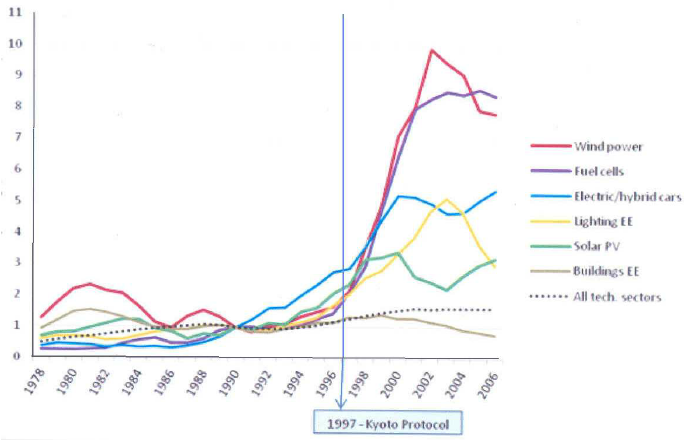
Innovation in climate change mitigation technologies, 1978-2006
Source: Zenghelis, Dimitri. (2011). A macroeconomic plan for a green recovery. Grantham Research Institute policy paper. A macroeconomic plan for a green recovery.
In the context of employment, green investment has a great potential to improve business competitiveness and create clusters of low-carbon innovation across Europe, with associated employment benefits, if accompanied by appropriate policies. The macro-economic analysis conducted as part of the Impact Assessment of ETS2 shows that the “impact of an increase in climate ambition to -55% on aggregate employment would be relatively limited, ranging between -0.26% and +0.45%”. Moreover, the employment impacts are positive if “carbon pricing revenues are recycled to lower other taxes or to support green investment”. This is evident since several assessments have demonstrated that for the same level of investment, more jobs can be created in green sectors than in fossil fuel sectors.
Naturally, the green transformation will have dissimilar impacts in different sectors and on different skilled workers. Significant challenges for workers, such as moving from one job to another or even to other sectors requiring new skills, will need to be addressed and carefully managed, with reskilling and upskilling measures. ETS2 auctioning revenues could be used for this purpose, as could other funds – the Just Transition Mechanism and Cohesion Policy funds. Overall, if these challenges are taken into account in the new policy measures, models presented in another Commission Impact assessment predict a positive impact on total employment by 2030.
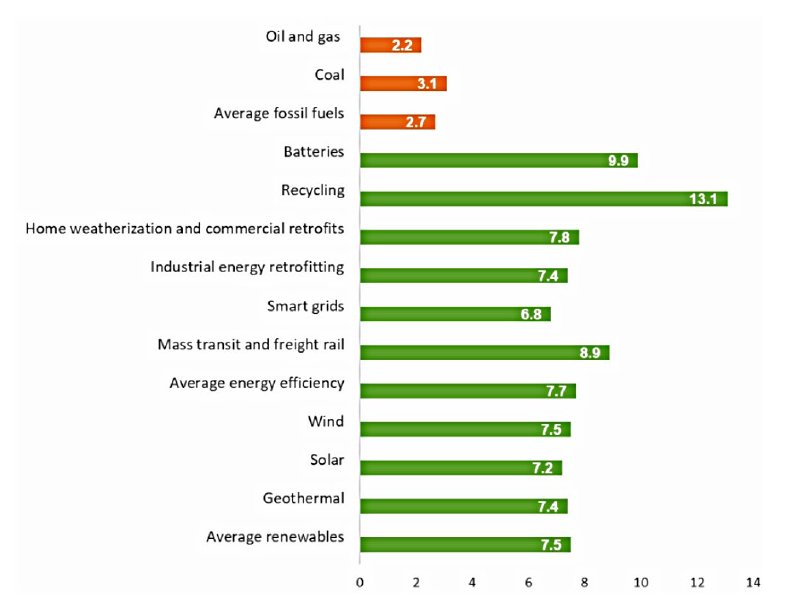
Full-time equivalent jobs created per USD million invested
Source: CAN Europe, based on IEA, 2020; Garrett-Peltier, 2016; Garrett-Peltier & Pollin, 2009
Opportunity costs
As the World Bank’s study „Where is the wealth of nations? Measuring Capital for the 21st Century” has demonstrated, a modern economy’s development depends overwhelmingly on the availability of intangible capital (i.e., the state of human resources) and much less on that of produced capital (like fossil fuels). Thus, subsidising fossil fuels instead of supporting the development of human resources entails huge opportunity costs. (Opportunity cost is the loss of potential gain from other alternatives when one alternative is chosen.)
Composition of the total wealth of the countries of the world
| Income group of countries | Natural capital | Produced capital | Intangible capital |
| Low-income | 26 | 16 | 59 |
| Middle-income | 13 | 19 | 68 |
| High-income | 2 | 17 | 81 |
| World | 4 | 18 | 78 |
Capital: Anything that confers value or benefit to its owners
Natural capital: Stocks of water, land, air, and renewable and non-renewable natural resources
Produced capital: Physical assets created by human beings.
Intangible capital: Human capital (knowledge, skills, know-how, good health) and the quality of formal and informal institutions.
Source: The International Bank for Reconstruction and Development/The World Bank, 2006
Reducing inflation
Although several governments expressed their fear of rising energy prices due to ETS2, fears of inflation due to carbon pricing are overblown. Carbon pricing will increase energy prices, but it will not increase energy costs: the higher amounts that consumers pay are actually costs they have already been paying anyway – albeit indirectly in the form of taxes spent on energy subsidies by governments. If the government fairly redistributes revenues from carbon pricing, households’ purchasing power will not be diminished. In fact, they will have more freedom to decide whether to spend their money on energy or other goods and services. (Even the energy poor will have more freedom because, in case the revenues are redistributed in favor of the poor, the compensation they receive will exceed the energy price increases; see, as an example, the concrete figures for the proposed revenue redistribution related to car transport in Hungary.) Certainly, energy and transport poverty must still be addressed to ensure targeted support for the most vulnerable.
In addition, the increase in fossil fuel prices could lead to an overall decrease in prices in the medium and long term (and occasionally in the short term). Namely, governments, companies, and individuals will make better decisions about how they spend their money (among others, by chosing less carbon-intensive products and services), resulting in a more sustainable economy. Moreover, in recent years, inflation has been driven more and more by climate change. More frequent and severe draughts, floods, forest fires, extremely strong winds and immense storms are taking an enormous toll on human resources, energy and transport infrastructure, buildings, and agriculture. . Especially, food prices have been skyrocketing all over the world.
Avoiding the costs of inaction
Alongside figures showing the economic benefits of climate action, such as ETS2, it is also necessary to consider the costs of inaction. Warming in Europe is much higher than the global average, and the economic cost of extreme weather events has risen, totalling €162 billion over the past 3 years. According to a 2025 analysis by the European Academies Science Advisory Councils, the cost of repairing extreme weather events (storms, heatwaves, droughts, and floods) could easily “wipe out up to 2.3 percent of Europe’s GDP by mid-century – a recipe for permanent recession, with economies shrinking, businesses failing and unemployment rising sharply”. A 2024 World Bank review estimates that the projected cost of inaction in a high-warming scenario could be as high as 7 percent of EU GDP. The World Economic Forum concluded that “for every $1 invested in climate adaptation, investors could see between $2 and $10 of net economic benefit, and more in some cases.”
These predictions largely stem from the factual losses in recent decades. Weather- and climate-related extremes caused economic losses of assets estimated at EUR 738 billion from 1980 to 2023 in the European Union. As shown in the graph below, these losses have substantially increased in the last 43 years; 22% of them (EUR 162 billion) occurred just between 2021 and 2023.
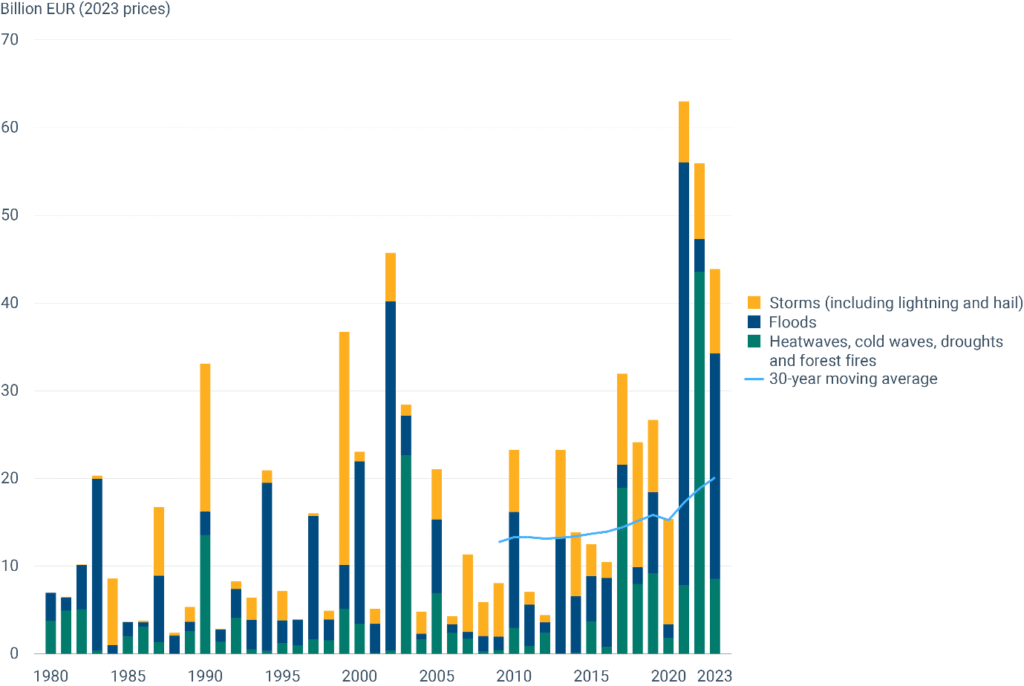
Annual economic losses caused by weather- and climate-related extreme events
in the EU Member States, 1980-2023
Source: European Environmental Agency
Besides contributing to CO2 emission reduction, the implementation of ETS2 will also lead to a decrease in other environmental harms (e.g., air pollution, water pollution, habitat destruction, noise, and waste generation). This would also have led to enormous economic benefits, as exemplified by The costs of not implementing EU environmental law study which estimated that “the costs and foregone benefits for the EU to be around EUR 55 bn per year (in 2018) from not achieving the environmental targets specified in the EU environmental legislation for seven policy areas: air and noise, nature and biodiversity, water, waste, chemicals, industrial emissions and major accident hazards, and horizontal instruments.”
However, it is highly probable that the studies cited above grossly underestimate the risk. Günther Thallinger, board member of Allianz SE, one of the world’s biggest insurance companies, recently noted that “the climate crisis is on track to destroy capitalism, with the vast cost of extreme weather impacts leaving the financial sector unable to operate.”
In conclusion, postponing the ETS2 would only benefit extremely polluting established industries, waste public money (due to enormous opportunity costs and the continuation of providing harmful subsidies), and delay the inevitable transition to a better functioning economic system. Therefore, ETS2 and its accompanying measures should be implemented not only to combat climate change, but also to strengthen and modernize our economy.
The opinions put forward in this document are the sole responsibility of the project partners and do not necessarily reflect the views of the German Federal Ministry for the Environment, Climate Action, Nature Conservation and Nuclear Safety (BMUKN).