Everyone must be compensated when fossil fuel prices rise
Author of article is András Lukács, the President of the Clean Air Action Group in Hungary in the framework of the project Climate Fair Monitor.
Only Sweden submitted its plan for the Social Climate Fund by the June 20 deadline. This is worrying because the fund is intended to help households, which will have to pay more for heating and transport as a result of EU regulations.
Currently, the EU rules aimed at decarbonising heating and transport are very weak; however, the ETS2, i.e., the extension of the EU Emissions Trading System to buildings and road transport, which is set to come into force in 2027, could bring about significant change in this area. As a result of ETS2, everyone will face higher prices at petrol stations and on their heating bills. However, in order to prevent this from triggering widespread protests, which would also jeopardise the achievement of climate protection targets, the revenues generated by ETS2 must be redistributed to the whole population.
The enormous damage caused by emissions and the costs of the necessary restoration are currently paid for by the emitters themselves only to a small extent, if at all, which means that they are effectively receiving significant subsidies. The EU emissions trading system essentially means a reduction in this subsidy. ETS2, therefore, will result in a further reduction in subsidies.
The ETS2 generates significant revenues for the state. These revenues can be used for investments that reduce fossil fuel consumption, such as the insulation of buildings and the development of more environmentally friendly modes of transport. However, many environmental NGOs are calling for a significant portion of the revenues to be returned to all citizens in the form of direct cash payments. Thus, instead of supporting activities that increase carbon dioxide emissions, the state will now support people. Transferring money to citizens’ bank accounts (and paying cash to those who do not have a bank account) makes it unambiguous, transparent and credible to almost everyone that the introduction of ETS2 will not be bad for them – in fact, most people will benefit, as the Clean Air Action Group has previously demonstrated with a specific example.
Can be introduced immediately
Investments that enable energy savings take a long time to implement. For example, even renovating a single household cannot be done overnight, and it will take decades to modernise the energy efficiency of all residential buildings in any country. ETS2, on the other hand, will be introduced in a year and a half. This means that, however important investments in reducing household energy expenditure may be, it will be difficult to implement even a fraction of them within the remaining time. However, direct payments can begin even before the introduction of ETS2 (i.e., it can be credited by the government until revenues from ETS2 start to flow in).
Direct payments also provide a safeguard against possible price spikes. In emissions trading, it is impossible to predict the future price of carbon dioxide with any degree of accuracy. Direct payments, on the other hand, can be increased immediately if prices rise. If direct payments are paid monthly, everyone receives higher support almost immediately when prices rise. This is also a huge advantage over other types of support.
If ETS2 does not lead to price increases (for example, if consumption and thus carbon dioxide emissions fall due to a crisis similar to the 2018 financial crisis), there will be no need to introduce the climate bonus. However, it is worth preparing for the worst, rather than rushing at the last minute.
Reaches everyone
Although ETS2 only applies to fossil fuels, prices may rise for all products and services that require transport and heating for their production (including firewood, for example, as demand for it is expected to increase due to higher natural gas prices). Therefore, if the revenue from ETS2 were to be used only to support the end users of fossil fuels (e.g., car owners or natural gas heaters), many would rightly feel that this was discriminatory.
Moreover, even support provided on the basis of need is not always fair. If only the poorest households are targeted, this could cause serious discontent among middle-income households, whose purchasing power is also declining due to price increases. It is also possible that someone’s living conditions may change rapidly, which the support system is unable to track. A further problem is that if not everyone is entitled to support as a matter of right, those in need are often unable to claim the support to which they are entitled, as it is not always easy to reach the poorest. Support based on individual assessment often gives rise to local conflicts, too. (The mayor of a small town recently told me that some people had reproached him for giving aid to people who, although poor, spent the support on alcohol and tobacco.)
Helps to prevent environmental disasters
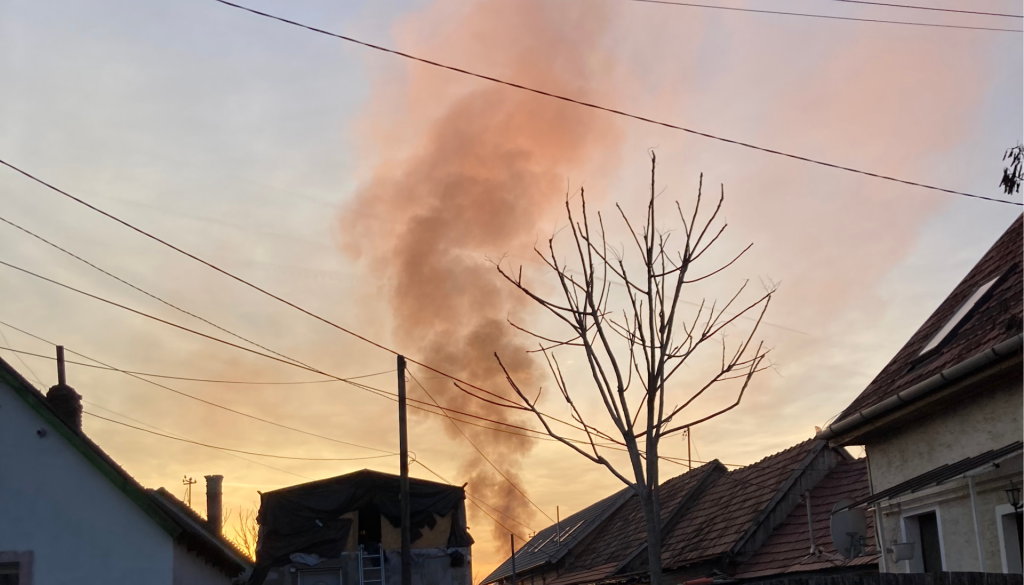
Due to rising heating costs, even more people are expected to heat their homes with wood. This is also indicated by the experience of the energy crisis: in 2020, 15 per cent of Hungarian households heated primarily with wood, and by 2022, this figure had risen to 37 per cent, causing huge air pollution in countless settlements. The situation was further exacerbated by the fact that the wood used for heating was largely inadequately dried, as burning wet wood pollutes the air to a much greater extent. Increased wood consumption could also have fatal consequences for our forests and climate.
The burning of waste in households is already widely practised not only in Hungary but practically in all Central and Eastern European countries. For example, a recent survey in Poland found that although only 6 per cent of respondents openly confess to burning waste, 46 per cent suspect their neighbours do so. Household waste burning releases large quantities of deadly toxins into the air, and it is likely to become even more widespread if energy prices rise.
By reducing the financial burden on households, direct payments help to prevent tragic environmental and health damage. (Direct payments alone are not sufficient for this; it is also necessary to introduce measures that the Clean Air Action Group has developed for the government and local authorities, with the cooperation and agreement of the relevant government officials. Of these proposals, the most important is undoubtedly the implementation of widespread and effective awareness-raising.) The World Economic Forum’s Global Risks Report 2025 states that misinformation and deliberate disinformation pose the greatest risk to the world, and this also applies to ETS2, direct payments, wood heating, and illegal burning…
Reduces social inequalities
Subsidies based on consumption are extremely unfair, as the rich consume more of almost everything than the poor. In all EU Member States, energy consumption by the richest 10% of the population is much higher than that of the poorest 10 per cent. For example, in Hungary, the richest 10 per cent of the population consume one and a half times as much natural gas and twice as much electricity as the poorest 10 per cent (meaning that, as a result of utility price cuts, the former receive one and a half times and twice as much support as the latter). Contrary to popular belief, car use is also heavily subsidised by the state (according to official government data, transport receives subsidies equivalent to 6 per cent of GDP); however, the richest 10 per cent of the population receive 10 times as much of this subsidy as the poorest 10 per cent. Therefore, in absolute terms, ETS2 hits the richest hardest. (It is another question that, in terms of proportions, the poor are worst off with rising energy prices, as they find it much harder to cope with any increase in expenditure.) Therefore, if ETS2 is introduced and all residents receive the same monthly subsidy at the same time, the poorest will benefit the most.
Although state support for improving the energy efficiency of buildings is necessary, experience to date shows that this support is predominantly received by wealthier households, thereby increasing social inequalities. Of course, this does not mean that these subsidies should be abolished, but that they should be used more effectively and in a more socially equitable manner.
Transparent
People are much more accepting of carbon price increases if they know exactly where their money is going, so we must avoid ETS2 revenues disappearing into the black hole of the state budget. Direct payments, on the other hand, are a tangible and very simple way of making everyone aware that the price increase caused by ETS2 – accompanied by direct payments – does not reduce but increases the purchasing power of households (except for wealthy households, which do not need further support anyway). There is hardly any more credible communication in this area than the monthly cash payment.
Unlike the use of revenues for other subsidies, direct payments cannot be abused, meaning that corruption and rent seeking are unlikely to occur. This is because every citizen receives an equal share of the support, eliminating the possibility of discrimination. Furthermore, experience with the Austrian and other similar systems shows that the administrative costs of such a system are also very low.
Already proven
Direct payments have worked effectively in many countries around the world. Hungary has also had a similar measure, which was a complete success. In 1976, the very generous meat subsidy was abolished, and as a result, meat prices skyrocketed. At the same time, everyone, including infants, received 60 forints per month, which was not a small amount at the time, representing 2 per cent of the gross average monthly wage and a much higher proportion for the poor. So, the poorest benefited the most, as they consumed relatively little meat, and even then only the cheapest varieties.
Photo by Ferenc Susánszky, Clean Air Action Group